"Alpine tours don’t always need ideal Conditions to be perfect."
LENA KOLLER, ORTOVOX ATHLETE
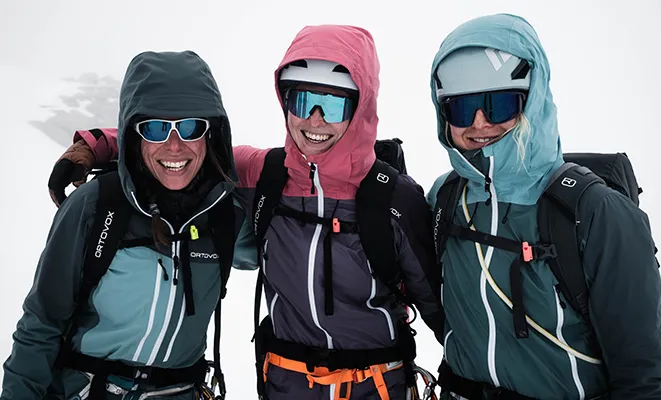
How far do you go when others turn back? What constitutes good vibes in a rope team – and why is trust so important? Lena, Marlies and Tanja arranged to meet in the Festsaal der Alpen [ceremonial hall of the Alps] for a joint tour – with different levels of experience. On the east pillar of Piz Palü they didn’t find a view, but they did reach an insight: It’s not postcard-perfect weather that makes a tour perfect – it’s having the right people with you.
The three members of the rope team
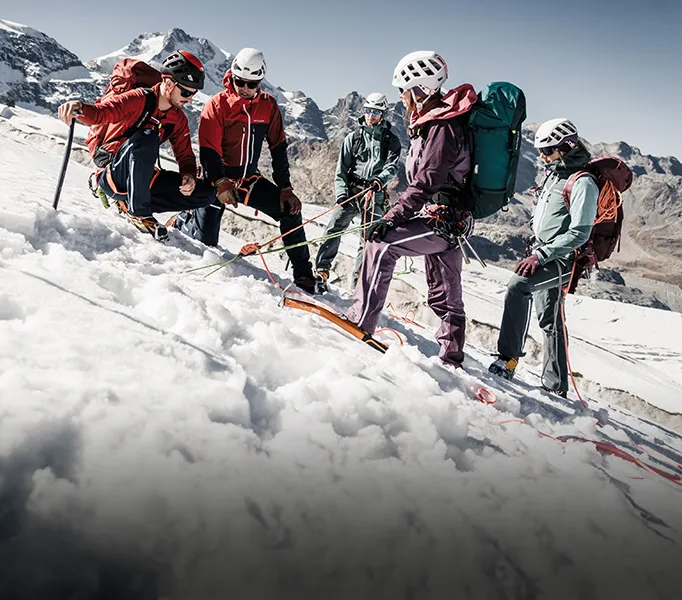
Their high alpine tour to Piz Palü starts not on the Diavolezza in Switzerland, but weeks before in Munich, South Germany, with the very decisions on how you can do the most right or wrong in the mountains. Choosing a tour. Which summit calls to them? Which route suits their ability and configuration? Tanja Gutheil is Communication Manager at Ortovox, super sporty, but a greenhorn on glaciers and ridges. Lena Koller is fully motivated in her training to become a mountain guide. And Marlies Czerny is a freelance author who knows every 4000er in the Alps from atop. None of them are familiar with the Piz Palü east pillar. “Choosing a tour that doesn’t overtax anyone, but still challenges them, requires careful consideration. If you find the right dose, everyone can develop in leaps and bounds,” explains Marlies, speaking from experience. “And there’s a good change that special tours will become special memories.”
A gothic glacial palace
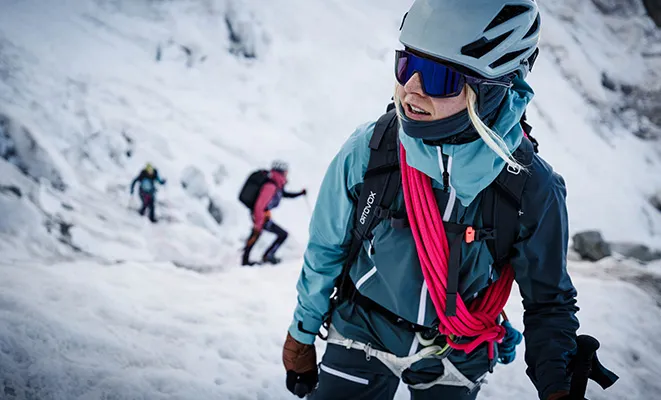
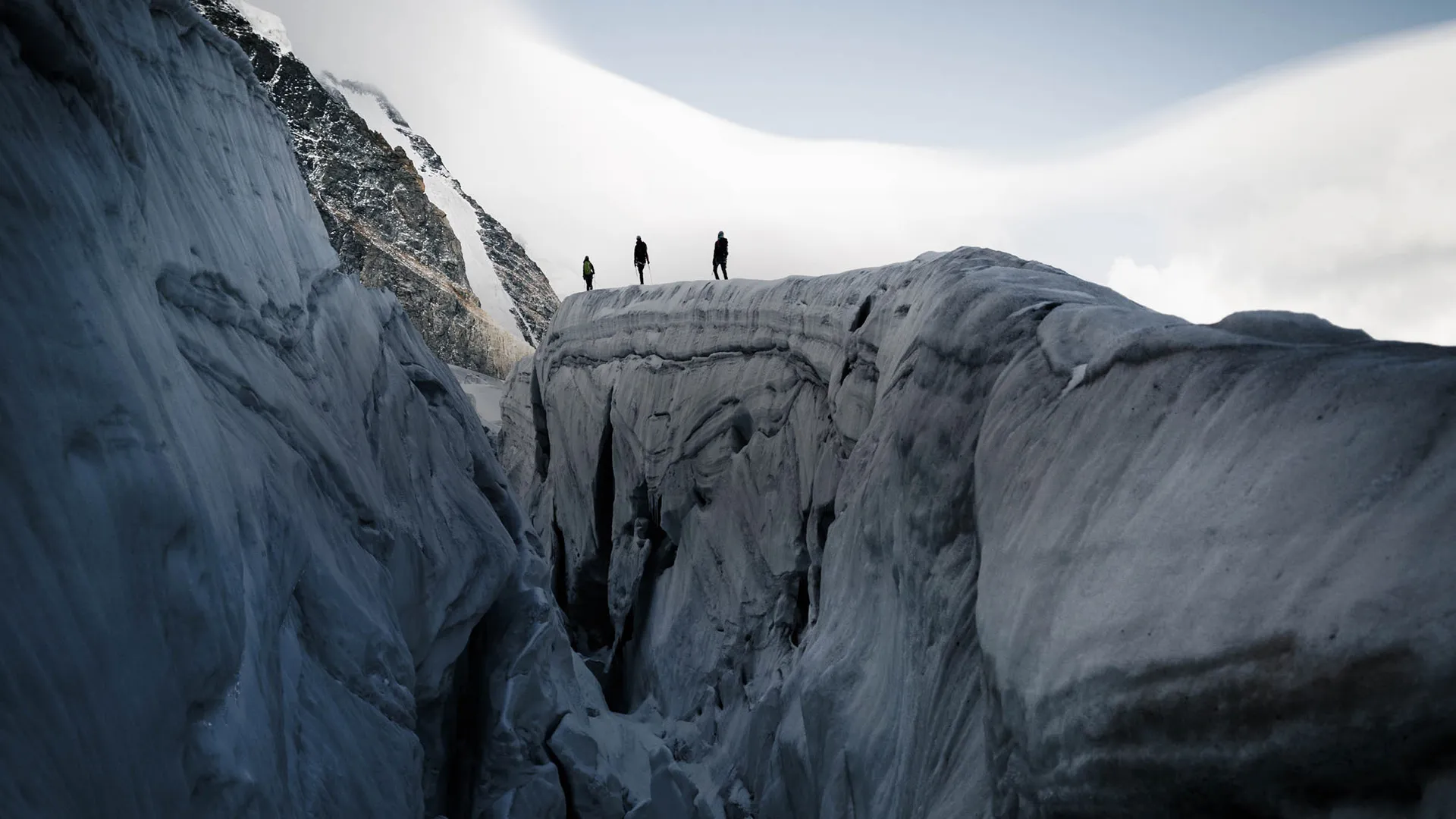
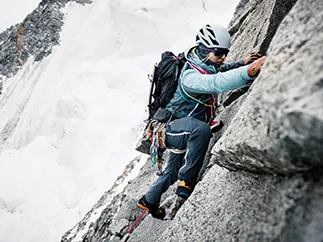
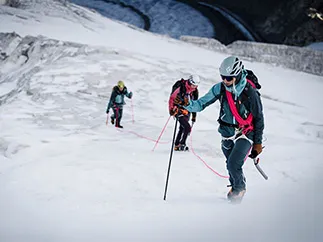
Piz Palü is one of these special places in the Alps. A white, esthetic glacial palace reaching heights of almost 3900 meters, it rises up in the Swiss Engadine on the border with Italy. Three distinctive granite pillars stand out from its north face. Cascades of jagged ice slumber in between. According to alpine literature, its left column – THE EAST PILLAR – IS THE EASIEST AND ALSO MOST BEAUTIFUL RIDGE. The three mountaineers think it’s the perfect challenge. Anyone talking about the “Festsaal der Alpen” usually means this area of the Bernina Range. It is geographically classed as part of the Eastern Alps, but visually takes on the dimensions of the Western Alps. Only when you see this glacial world for yourself do you see it with different eyes. “It’s just incredibly beautiful and impressive,” marvels Tanja. “You feel so small and insignificant.” It is a privilege of our time to be able to see something that will have largely disappeared from the Alps by the end of the century due to global warming. After spending the night at Berghaus Diavolezza, the three-person rope team is at the Pers Glacier at dawn. They move up through an eerie labyrinth of crevasses to the start of the east pillar. They feel the backpack of responsibility – which we as humanity all carry for the next generation – weighing more heavily than usual on their shoulders. On this August day, Piz Palü is shrouded in clouds. They cover the summit ridge. Nothing about the bitterly cold northwesterly wind suggests summer. Conditions on a high alpine tour change from day to day, and sometimes even within one single day. Decisions, both big and small, are made non-stop. Are we as a rope team up to these conditions? How far can we go before it stops being fun? When does it stop making sense? Where are we going? Left, right? Where should we belay? It is this constant comparison with reality that makes high alpine tours so intense. “You learn so much in just a few hours,” continues Tanja, “For me, it is exactly these decisions that are unusual and exciting.” What gives you support on a narrow ridge when you’re doing something like this for the first time? Is it really the rope? For Tanja it was the great feeling within the group and her trust in the two old hands. But also the trust that they placed in her. For the high alpine touring rookie, the start to the east pillar was the hardest part. A big step over the randkluft to the rocks. A vertical step, ice-cold granite. Tanja reaches her limits at the first belay station. She’s full of doubt, her blood pressure is at rock bottom. “Can I manage it? I felt so awful – I couldn’t feel my fingers for the cold and didn’t know what was still to come.” A few warming words. A few tips to help get through difficult spots. A “you can do this” or “well done” is often more effective than a sturdy pull on the rope. Soon, the South German is back in her comfort zone. With every step, she becomes more accustomed to this unfamiliar terrain. And enjoying spending time in a group of women. “I get the feeling that everything is a bit more relaxed. In my view, girls are more sensitive, more empathetic, take care of each other and celebrate the experience together.” Out with peer pressure, in with feelings. “You're all a kind of role model for each other and that’s encouraging and inspiring,” says Lena, who also works as a mountain bike guide. “Direct role models in which we – to an extent – can see ourselves, are often far too rare in the mountains.”
Choosing a tour that doesn’t overtax anyone, but still challenges them, requires careful consideration. If you find the right dose, everyone can develop in leaps and bounds.
Being at the limit on ice-cold granite
The high mountains are always the stronger characters. Gusts of wind start to pick up. Visibility is getting worse. The male rope team that left before them passes by them again in the other direction. They’ve lost their sense of enjoyment in the storm and are turning back. The three women put their heads together. They check the weather report again. It looks like anything other than a friendly invitation to continue climbing, but there are no reservations, just a joint decision. They add another insulating layer under their Westalpen jackets, put up their hoods and continue on. Nowhere else can you be so exposed to the elements as on a high alpine ridge. The hanging glaciers to the left and right of the east pillar are terrifying. You have to be really sure of yourself here. They are sure. After the frosty but fantastic climb on the razorback, the steep rock finale awaits – peppered with firn, meaning they also have to use ice screws. “I gulped at that moment,” admits Tanja. “It was a little steeper than expected.” But here, too, she moved confidently and safely higher. “I love trying new things and pushing myself to my limits. This environment provided just the right amount of adventure and challenge.” Growing beyond your limits, growing together as a group: the essence of a successful rope team.